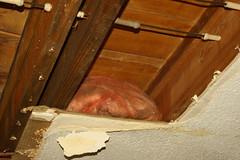
Do you see what I see?
Yes! That's fiberglass insulation! But what is fiberglass insulation doing under this untouched plaster? Right - not so untouched.
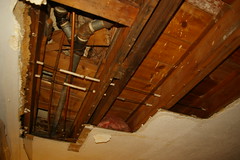
I must credit the quality of the plaster work on whoever did the work here - it is really impressive. The ceiling is made of a material that appears to be similar to drywall, only a bit more dense and only about 16" wide. It is about 5/8" thick and runs perpendicular to the joists. The seams on the joists are held together by metal lathe and a layer of plaster about 1/2" thick. If not for the water, this repair work would have been bulletproof. The metal lathe gripped the crown moulding at the edges - there's no way I could have gotten it apart.
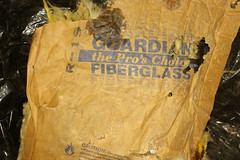
Perhaps this fiberglass will help date the work.
I'm really really glad that I tore out the plaster. There was some mold where the water had been sitting. There was also evidence of some sort of small rodent's nest in the fiberglass.
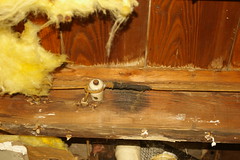
Another concern I will be addressing is this bit of knob and tube - it seems that the junction overheated a bit, probably due to being covered with fiberglass.
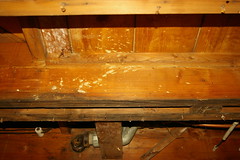
Further, this joist has a disconcerting crack in it - I'll probably be sistering it up before everything goes back together.
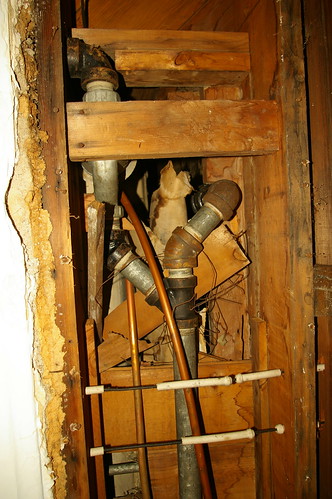
I'm not going to ask about the various loose pieces of wood here.
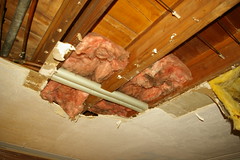
Finally, while insulating hot water pipes is important, I'm not sure that notching joists to this extent is the proper course of action in order to accommodate the insulation.